博文

目前显示的是标签为“organic fertilizer production”的博文

Huaqiang Heavy Industry: Organic Fertilizer Equipment Installation Site in Laos

图片
A look at the installation site of Huaqiang Heavy Industry’s organic fertilizer project in Laos: beneath a steel-structured fermentation shed, a large wheel compost turner spans the width of the fermentation pit. Components and tools are neatly arranged, and a team of local and international staff collaborate to systematically assemble the core fermentation equipment, offering a clear view of the overseas project's construction progress. The large wheel compost turner is designed for continuous production in large-scale organic fertilizer plants. Capable of turning material to a depth of several meters and covering a wide operational area, a single unit can handle the fermentation workload for high-volume output. It minimizes manual labor and reduces operational costs, making it the preferred fermentation equipment for large-scale organic fertilizer projects. To suit the tropical climate of Laos, the equipment has undergone upgrades for rust and heat resistance, thereby extendi...

What are the differences between the production of bio-organic fertilizer and organic fertilizer?

图片
Organic fertilizer is a core fertilizer for modern agriculture in improving soil and promoting green planting. Many people only know the effects of the two types of organic fertilizer, but they don't understand that the core difference lies in the production process. Although bio-organic fertilizer and conventional organic fertilizer use similar raw materials, their production processes, technological standards, core processing techniques, and finished product requirements are completely different, resulting in significant differences in their functions. The requirements for raw material pretreatment differ significantly. Conventional organic fertilizer production has a lower barrier to entry, mainly using livestock and poultry manure, crop straw, and agricultural waste as raw materials. It only requires simple sorting and impurity removal to remove large impurities before entering the fermentation stage, with no strict requirements on the microbial community or purity of the raw m...

What is a Trough type Compost Turner?

图片
A trough type compost turner , also known as a trough-type compost turning machine, is a core piece of specialized equipment in the aerobic fermentation process of organic waste. It is mainly used for the fermentation, composting, and harmless treatment of materials such as livestock and poultry manure, municipal sludge, straw, and kitchen waste. It is a key piece of equipment for modern organic fertilizer plants and environmental treatment stations to achieve large-scale production, and a significant driver in transforming organic waste into valuable resources. Structurally and in terms of working principle, the trough type compost turner adopts a design combining track-mounted walking and rotary turning, relying on a pre-cast concrete fermentation trough for operation. The main body of the equipment is mounted on a track at the top of the trough, driven longitudinally by a walking motor. The high-strength teeth on the turning rollers can penetrate 1.2-2.5 meters into the material lay...

How the Large Wheel Compost Turner Works

图片
In scenarios involving large-scale organic fertilizer production and livestock manure treatment, the large wheel compost turner has emerged as a pivotal piece of equipment for facilitating the maturation and fermentation of organic waste, thanks to its advantages of wide span and high efficiency. Through scientific structural design and precise operational logic, it automates and scales up the traditionally laborious task of manual windrow turning—thereby simultaneously boosting efficiency and guaranteeing fermentation quality. The working principles underpinning this machine are a testament to sophisticated technical ingenuity. The operation of the large wheel compost turner relies on the synergistic interplay of its core components, which primarily consist of the turning disc, transmission system, locomotion mechanism, and control system. The turning disc—the machine's central component—is fitted with multiple layers of radially arranged blades or paddles. Driven by an electri...

What are the advantages of a large wheel compost turner compared to a regular compost turner?

图片
In the fields of aerobic fermentation of organic fertilizer and harmless treatment of organic waste, compost turners are indispensable core equipment. Compared to regular compost turners, large wheel compost turner s, with their unique structural design and technological advantages, have become the preferred choice for large-scale processing scenarios. They achieve comprehensive upgrades in efficiency, adaptability, and fermentation effect, effectively solving the pain point of regular compost turners being "inadequate" in large-scale projects, and injecting efficient momentum into the industry's development. The most prominent advantage of the large wheel compost turner is its higher processing efficiency and stronger adaptability to large-scale scenarios. Regular compost turners typically have a turning span of less than 3 meters and a depth of less than 1 meter, with a daily processing capacity generally below 300 tons. Facing the massive amounts of material from live...

What are the advantages and disadvantages of windrow compost turning machines?

图片
As a core piece of equipment in organic fertilizer production and livestock manure treatment, the windrow compost turning machine adapts to various complex working conditions thanks to its unique walking structure.  Its performance directly affects work efficiency and material processing quality. The following will analyze the main advantages and disadvantages of crawler-type compost turning machines in detail. The advantages of windrow compost turning machines are quite prominent. Firstly, they have excellent terrain adaptability. The crawler design increases the contact area with the ground, reducing ground pressure. This allows them to travel smoothly on soft fermentation material piles without getting stuck or slipping, and also adapt to rugged terrain such as fields and mountains, offering a much wider operating range than wheeled compost turning machines. Secondly, they offer superior turning and mixing effects. The equipment is usually equipped with a powerful power system...

How to Pre-process Materials When Using a Windrow Compost Turning Machine?

图片
As a core piece of equipment in organic fertilizer production and waste treatment, the operating efficiency and processing effect of a windrow compost turning machine largely depend on the scientific pre-processing of materials. Proper pre-processing can prevent equipment malfunctions, optimize the fermentation environment, and is fundamental to ensuring smooth subsequent production. The following details the key aspects of material pre-processing for crawler-type compost turners, starting from the core points. First, strict control of material particle size is necessary, requiring crushing and screening. Crawler-type compost turners have specific requirements for material size. Overly large materials (such as straw, dead branches, and large pieces of organic fertilizer raw materials exceeding 50mm in diameter) will increase turning resistance, leading to insufficient turning, affecting fermentation uniformity, and potentially wearing down the equipment's tracks or jamming mechan...

How to Extend the Service Life of Windrow Compost Turning Machines

图片
As a core piece of equipment in organic fertilizer production and waste treatment, the service life of windrow compost turning machine s directly impacts operational efficiency and costs. To effectively extend the equipment's lifespan, a systematic management approach is needed, encompassing operation, maintenance, and environmental adaptation, to maximize the equipment's value. Standardized operation is fundamental to extending lifespan. Operators must receive professional training and strictly follow operating procedures: Before starting, conduct a comprehensive check of key components such as track tension, engine oil level, and hydraulic system sealing to avoid operating with faults; during operation, maintain a constant speed, avoiding sudden acceleration, sharp turns, and overloading during composting to prevent instantaneous impact on the tracks and transmission system; after operation, promptly clean material residue from the equipment, especially removing debris from...

How to deal with livestock manure on large farms

图片
For farms, the biggest environmental problem is that there is no place to stack a lot of feces. If these excrement are not managed scientifically, it will harm human and animal health and pollute the surrounding environment. The aquaculture industry needs to be carried out, and environmental protection treatment also needs to be paid attention to, so what are the methods of manure treatment in the farm? How to deal with feces to achieve harmless requirements? Is there a technology that saves money and is simple? The most effective way is to use organic fertilizer production equipment to process manure into fertilizer products. How to make waste into organic fertilizer is an urgent need for farmers to understand. What kind of process is simple and can solve the problem to the greatest extent? If the feces of the farm are treated innocuously, several aspects should be paid attention to: 1. Collect and stack dry manure. The stacking place must be rainproof and impermeable, and be c...

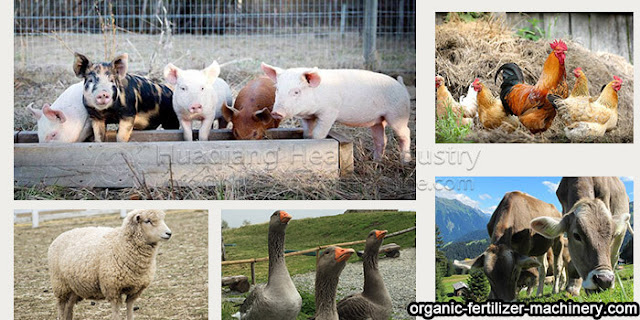
How to deal with manure in animal farm

图片
The animal farm produces a lot of animal excrement and related waste every day, which is also a great fortune. It is a reliable and economic method to ferment farm manure compost into organic fertilizer by using organic fertilizer production equipment . Composting and fermentation of farm manure The fresh animal excrement is mixed with wheat bran or rice bran according to the proportion, and the fermentation strain is added, and the mixture is even, which is the fermentation raw material to be used. After the manure is mixed evenly, it will be piled up into a material pile with height of about 1.2-1.5m, width of no more than 1.5-2m and length of no limit. Fermentation tank can also be built to put feces into fermentation. The water content should be controlled at about 50% (Note: depending on the degree of drying and wetting of fermentation materials, the appropriate water content judgment method for materials is to hold the materials in groups, see the water through the fingers, ...